FACELAB · GUIDE
Under-eye patches: what they do and what they cannot
Patches are one of the few skincare products whose effect is visible immediately. That is exactly why they attract the most exaggerated promises. Here is the mechanism behind them, and where the limit lies.
What a patch actually does
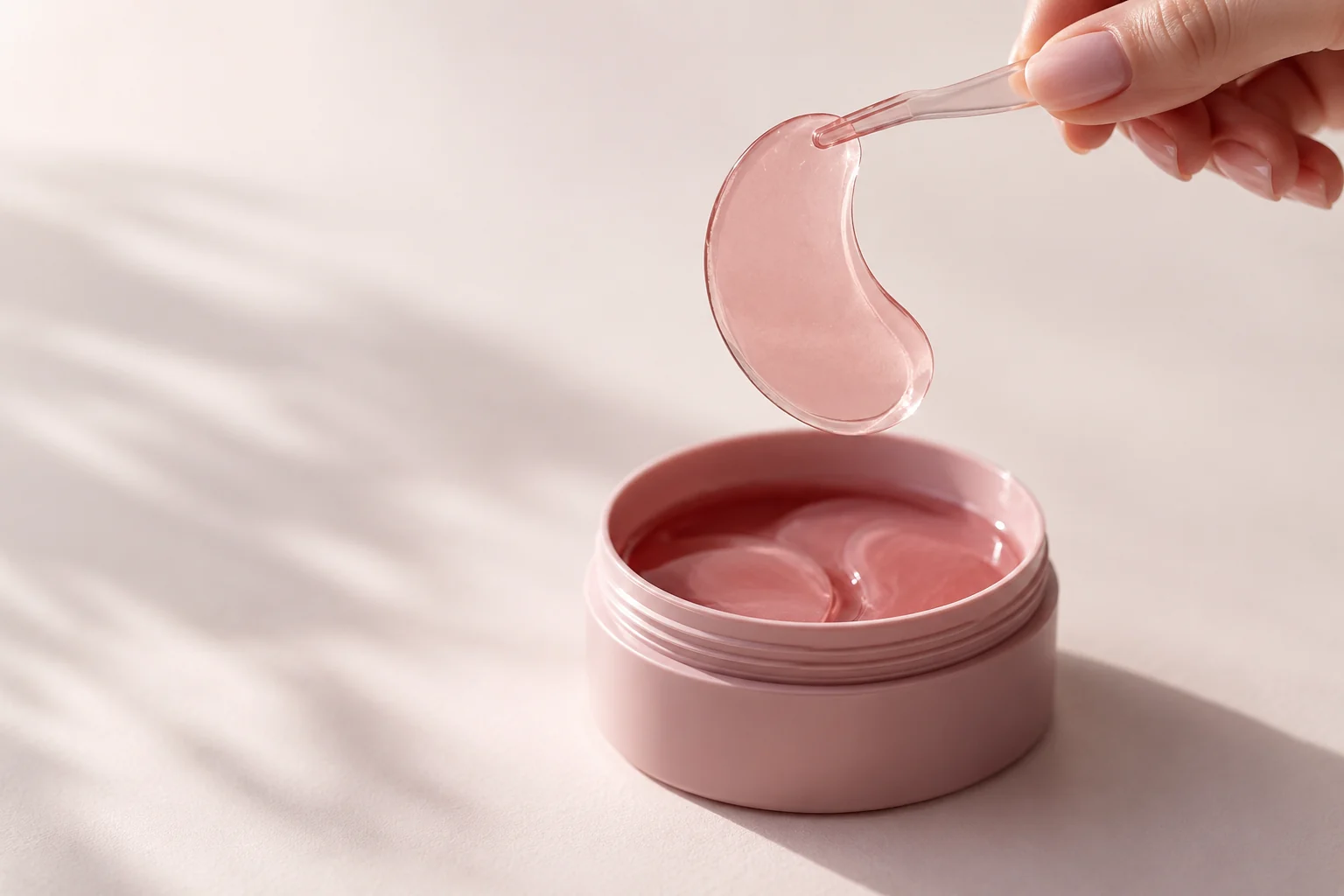
A patch is a piece of hydrogel or soaked fabric that sits tightly against the skin and blocks evaporation. The effect comes less from the formula than from the occlusion itself: under that seal the top layer of skin fills with water and smooths out. That is why you see the result the moment you peel it off — and why the result is temporary.
The skin under the eyes is the thinnest on the face: roughly half a millimetre against two on the cheeks. It has almost no oil glands, so it loses water faster and shows any swelling sooner. Patches look most effective there not because they are special, but because the area is.
Puffiness and dark circles are not the same problem
Confusing the two is the main source of disappointment. Puffiness is fluid: overnight the body is horizontal, lymph drains more slowly, and excess water collects where the tissue is loosest. Salt, alcohol or a short night make it worse. Puffiness genuinely does go down — with cold, gentle pressure and a few hours upright.
Dark circles have at least three separate causes. Vascular: the network of vessels shows through thin skin, and the thinner the skin, the bluer the tone. Pigmentary: more melanin in the skin itself, often inherited or caused by rubbing. Structural: with age the fat pad in this area shrinks, leaving a hollow that casts a shadow.
A patch addresses none of the three. It can smooth the skin slightly, which makes the circle read lighter, but the cause stays exactly where it was.
How to tell which kind of circle you have
There is a simple test at home. Stand in front of a mirror in daylight and gently stretch the skin under one eye sideways, without pressing. If the colour fades, the circle is vascular: the skin stretched, the vessel network thinned out, and the tone went with it.
If the shade stays exactly the same, it is pigment. It lives in the skin itself and stretching will not move it. And if the colour shifts noticeably with the angle of light and almost disappears when you look up into the mirror from below, it is a shadow cast by a hollow — a structural cause.
The distinction is not academic. Vascular circles respond to cold and caffeine, pigmentary ones to niacinamide and sun protection over months, structural ones to a light-reflecting concealer or to procedures. In all three cases a patch gives the same modest smoothing effect, and nothing more.
Hydrogel, fabric, collagen
Hydrogel patches hold their shape, do not slide and dry out more slowly. They are the practical choice if you plan to walk around the flat while wearing them.
Fabric ones are cheaper but shift easily and lose moisture quickly. Use them lying down, and take them off sooner.
So-called collagen patches are mostly hydrogel with hydrolysed collagen added. The collagen molecule is far too large to pass through skin, so it works as a surface humectant rather than as building material. That does not make it useless, but it does not justify the price difference either.
Which ingredients matter
Caffeine temporarily constricts blood vessels — the shortest route to less puffiness and a slightly less blue tone. The effect lasts a few hours.
Hyaluronic acid holds water in the upper layer, reinforcing the same occlusion. Niacinamide does work on pigmentation, but it needs weeks of regular use — twenty minutes in a patch will not do anything.
Gold, diamonds and pearl in the ingredient list are marketing. They have no demonstrated effect on skin, and they appear at concentrations that change nothing.
How long to wear them, and how to place them
Ten to twenty minutes is the useful window. The rule that matters: take them off while they are still damp. A dried-out patch reverses direction and pulls moisture back out of the skin.
The wider end goes toward the outer corner of the eye, the narrower one toward the inner. Leave two or three millimetres between the patch and the lash line so the product cannot reach the eye. Apply to clean, dry skin before moisturiser, never over it — otherwise the cream becomes a barrier and there is no occlusion.
Do not rinse off what is left behind. Tap it in with your fingertips until it absorbs.
Cold matters more than the formula
Keep the jar in the fridge and the same patches will work noticeably better. Cold constricts vessels, and that removes puffiness faster than any ingredient on the list.
It is the same mechanism behind a chilled spoon or simply splashing cold water on your face. A patch adds moisture on top of the cold, which is why it wins the comparison — but temperature does the heavy lifting.
Common mistakes
- Leaving them on until fully dry — the skin loses more water than it gained.
- Applying over cream or onto unwashed skin — the seal never forms, so there is no occlusion.
- Using them daily and expecting a cumulative result — the mechanism is single-use, it does not build up.
- Dragging the skin while removing them — thin skin stretches easily and recovers poorly.
- Placing the patch right against the lashes — product creeps into the eye and stings.
- Applying makeup immediately after — the skin is still damp and foundation goes patchy. Give it five minutes.
What patches will not do
They will not remove pigmentation, change the structure of the skin or affect lower-lid fat herniation. They do not replace sleep and cannot offset chronic sleep debt — the puffiness returns the next morning.
Their realistic job is different: in twenty minutes, bring the under-eye area to a state where concealer sits on it properly. For the morning before something important, that is entirely enough.
This article is educational and is not medical advice. If under-eye swelling is persistent, appeared suddenly or comes with other symptoms, that is a reason to see a doctor rather than to buy another box of patches.