FACELAB · GUIDE
Makeup brushes: shape matters more than price
A twenty-piece brush set will not improve your makeup if you do not know what separates one shape from another. There are really only three base shapes, and each solves a different problem.
What a brush actually does
A brush does two things at once: it picks up a certain amount of product and distributes it along a certain path. The shape of the bristles determines both. A densely packed brush grabs more product and lays it down concentrated; a loose, fluffy one picks up less and diffuses it.
That is why the same product can look completely different depending on the tool. It is not brand magic but simple mechanics: how much product reached the skin, and over how large an area it was spread.
Round shape
A domed brush with a rounded edge is the universal blending tool. It has no sharp boundary, so it leaves no hard lines: as you work in circles, the edge of the product is constantly diffused.
This shape suits powder blush, blending contour and working shadow through the crease. The key is not to press: the harder you push, the flatter the bristles splay and the wider the patch they leave.
Flat shape
A flat brush with a straight edge lays product down densely and precisely. It does not diffuse — it prints. That is exactly why it suits shadow on the mobile lid when you want saturated colour rather than a soft haze.
In a wider format, the flat shape is used for foundation: it gives heavier coverage than a sponge but needs blending afterwards, because it leaves visible streaks.
Angled shape
An angled cut gives the most precise line of the three shapes. The slope of the bristles naturally follows the line of the cheekbone, the brow and the curve of the lid — which is why this shape is used wherever you need a controlled edge.
Classic uses: contour under the cheekbone, filling brows, lining with shadow. On brows an angled brush produces a short hair-like stroke, far more natural than one solid pencil line.
Three base brush shapes in profile
- Round — diffuses, leaves no edge
- Flat — lays product densely and precisely
- Angled — gives the most precise line
When a sponge or your fingers beat a brush
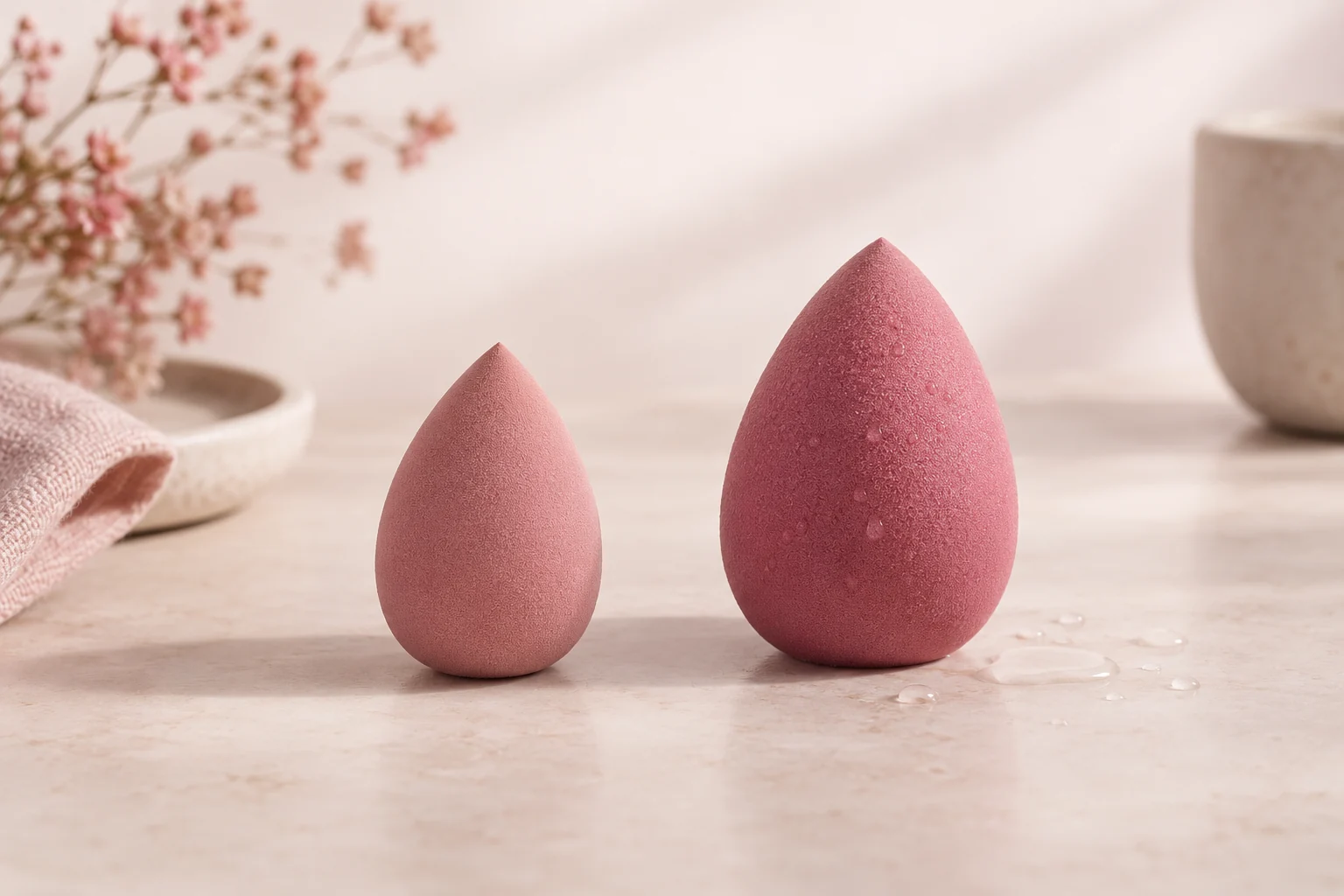
A damp sponge does not apply product so much as press it into the skin and lift the excess. That gives the thinnest, most natural foundation finish — something a brush struggles to match. The trade-off is waste, since the sponge absorbs part of the product.
Fingers have one irreplaceable advantage: warmth. Cream textures — blush, highlighter, contour — soften under body heat and melt into the skin in a way they never will under cold synthetic bristles.
Pressure and direction change everything
Most application problems are solved not by swapping brushes but by changing how hard you press. A light touch lays a thin layer that is easy to build on; heavy pressure drops a patch you then have to remove.
A working rule: apply less than you think you need, then add. Taking excess away is always harder than adding another layer.
Direction matters too. Working from the centre of the face outwards distributes product so coverage fades naturally towards the edges — and no boundary is visible.
How many brushes you actually need
Manufacturers sell twenty-piece sets, but the working minimum is far smaller. Four tools genuinely cover the ground.
A large domed brush for powder, blush and anything that needs diffusing over a wide area. A medium angled brush for contour and brows. A small domed brush for the crease. A small flat brush for packing shadow onto the mobile lid. Plus a sponge for foundation.
Everything else in those sets is a variation on these four shapes, or a specialist tool you will reach for twice a year. Four good brushes beat twenty mediocre ones: cheap bristles shed, lose their shape and blend unevenly.
Natural or synthetic bristles
The difference is not quality but which texture the brush is built for. Natural hair has a scaled surface that holds powder particles, so it picks up and diffuses dry products better. Synthetic bristles are smooth, so they do not soak up cream or drink it away, which makes them better for liquid and cream textures.
The practical rule is simple: powder, blush and shadow can go on natural hair. Foundation, concealer and cream contour need synthetic.
Modern synthetics handle powder perfectly well, so if you want one universal set, buy synthetic. The reverse does not hold: a natural brush loaded with cream clogs quickly and is ruined.
Care: why a dirty brush ruins the look
Bristles accumulate product residue, sebum and dead skin cells. A clogged brush stops blending and starts smearing, because the bristles have stuck together and no longer move independently.
Wash brushes used with cream textures weekly, powder brushes every two weeks. Dry them flat with the bristles just over the edge of a table: dried upright, water runs into the ferrule, dissolves the glue and the brush starts shedding.