FACELAB · GUIDE
Blush: the fastest step in makeup, and the one most often done backwards
Foundation evens out the face — and in doing so it wipes away its natural colour. Blush puts that colour back. It is the cheapest and fastest step in all of makeup: fifteen seconds of work, and the difference is visible even to people who cannot say what changed.
What blush is actually for
Foundation, powder and concealer all work toward evenness. They remove blotches, redness and shadows — and along with them the natural variation in tone that makes a living face different from a mannequin.
Blush deliberately puts that variation back, in the right place. That is why a face can look flat without it, even with perfectly matched foundation and contour and highlighter in place.
There is a flip side: blush is the most conspicuous product on the face. Nobody notices half a shade off in foundation, but blush in the wrong place or the wrong colour is visible across a room. So there are few rules here, and they are strict.
Textures: when to use which
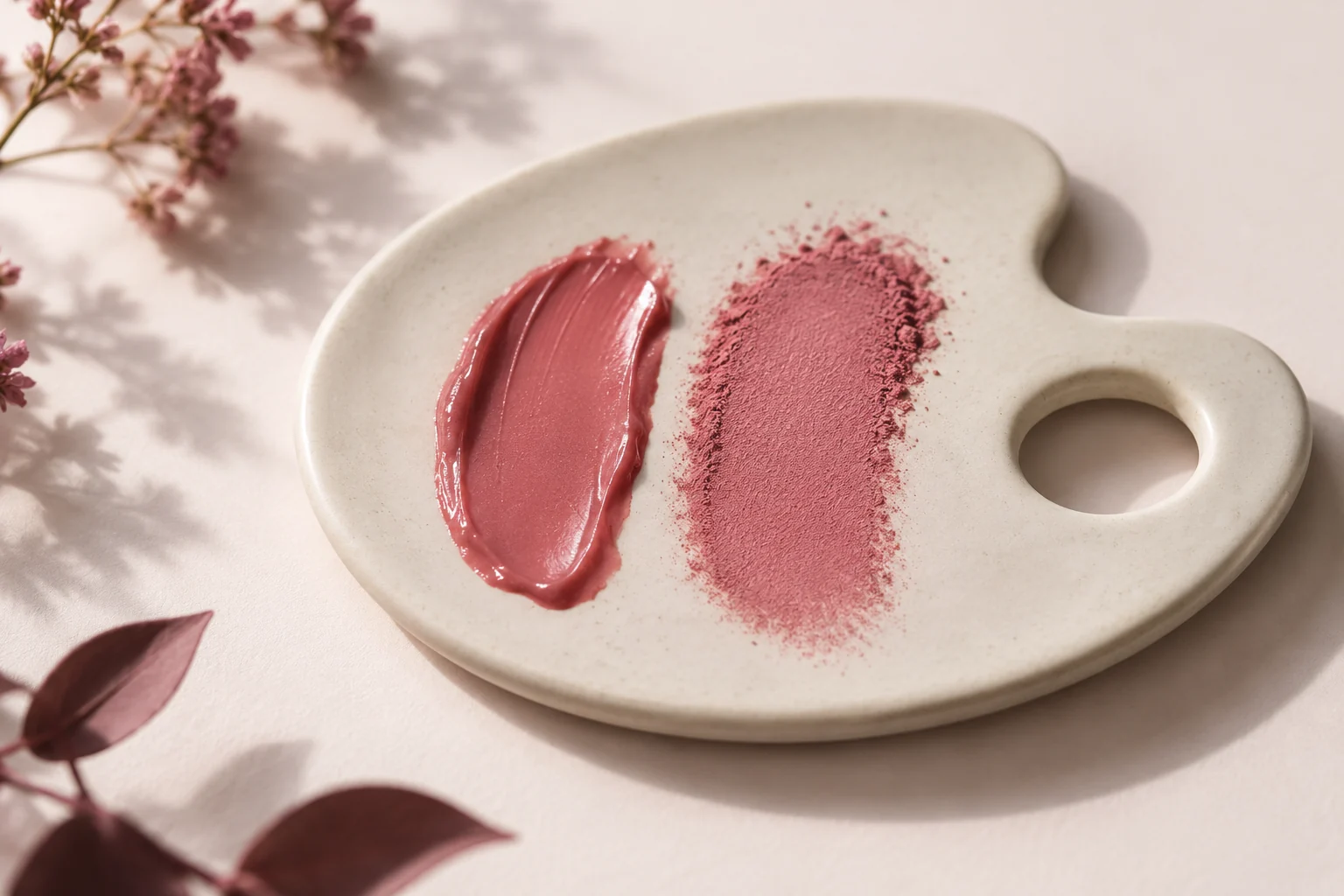
- Cream — sits on skin rather than on powder and reads as colour from underneath. The best choice for dry skin, and for an age where powder starts to emphasise fine lines. Apply with fingers or a sponge, before powder.
- Powder — the most controllable: easy to pick up a little, easy to blend, easy to build. For oily and combination skin this is the default. It goes over powder, not under it.
- Liquid and tint — the longest-wearing and most pigmented. They work fast and forgive least: a tint sinks into the skin within seconds, and the edge cannot be corrected after that. Apply in dots and blend immediately.
- Sticks — convenient when travelling, but they drag the foundation underneath. Better to swipe onto the back of your hand and pick the product up from there with a finger.
- Baked formulas and lip-and-cheek multiproducts — a compromise on every axis: less pigment, more versatility. A decent starting point if you do not yet know what suits you.
The three limits of the blush zone
The main mistake is neither colour nor quantity but placement. The zone where blush looks natural is bounded on three sides, and all three are easy to check in a mirror.
The lower limit is the level of the tip of the nose. Anything applied below it pulls the face downward: the blush reads as a shadow on the cheek rather than a flush.
The inner limit is an imaginary vertical line from the pupil. Do not bring product closer to the nose than that — it narrows the centre of the face and instantly reads as drawn on.
The upper and outer edge is the direction of work itself. Blend from the apple of the cheek up and outward, toward the temple. Sweeping down toward the jaw is a different product with a different job.
Where blush belongs and which way to blend it
- 1 — lower limit: never below the tip of the nose, or the face is pulled downward
- 2 — inner limit: no closer to the nose than a vertical line from the pupil
- 3 — blend up toward the temple, not down toward the jaw
Face shape: how much of that is real
The charts that prescribe one placement for a round face and another for a square one usually reduce to a single real variable — how high and how diagonal the patch sits.
Higher and more diagonal, closer to the temple, visually lengthens and lifts the face. Lower and rounder, right on the apple, makes it look softer and younger.
So the choice is not about skull geometry but about the effect you want today. Rounder faces more often want the first, longer faces the second — but that is a tendency, not a law.
The one genuinely universal rule: do not put blush and highlighter on the same highest point of the cheekbone. Two accents in one spot cancel each other out.
How much product you really need
Almost always less than it seems. A brush dipped into powder blush picks up enough for two or three faces. So after loading it, always tap the brush against the edge of the pan or against your wrist.
The working approach is two or three light passes rather than one heavy one. Adding is easy; taking away is not.
The first touch of the brush should land slightly off the intended centre of the patch. Wherever the brush lands first always holds the most product, and it is better if that spot is not the middle.
The same applies to cream formulas, counted in dots: three or four rice-grain dots per cheek is already enough.
What to apply it with
- A medium fluffy round brush is the all-rounder for powder. It leaves a soft patch with no visible edge.
- An angled brush when you want a defined diagonal toward the temple. Harder to control.
- Fingers are the best tool for creams: the warmth of your hand melts the texture into the skin.
- A damp sponge rescues an overdose of cream blush — it does not add product, it lifts and diffuses the excess.
- A dense flat brush is simply wrong for blush: it deposits a patch with a visible border.
Colour
The simplest reference is the colour your cheeks turn after a run or in cold air. That is your natural flush, and it always looks appropriate.
Cool undertones suit pink and berry shades, warm undertones peach, coral and terracotta. Neutral undertones take almost anything.
Saturation matters more than hue. A very deep blush on fair skin looks muddy no matter how well the undertone matches; a pale pastel on deep skin simply does not show. Aim for a patch that reads clearly without dominating.
When in doubt, go half a step more muted than what tempts you in the pan. Pigment always looks more restrained in the packaging than on the face.
Common mistakes
- Applying below the level of the tip of the nose — it visually drags the face down.
- Bringing the patch closer to the nose than a vertical line from the pupil.
- Blending down toward the jaw instead of up toward the temple.
- Putting powder blush on unpowdered oily skin — it grabs and goes patchy.
- Putting cream blush over powder — it pills and drags the foundation with it.
- Loading the brush and touching the cheek without tapping off the excess.
- Placing highlighter on the exact spot where the densest part of the blush already sits.
- Judging the result under yellow bathroom light and then walking out into daylight.
If you overdid it
The simplest fix is a clean fluffy brush with no product, swept over the patch. It does not remove pigment — it spreads it across a larger area, and the intensity drops by half.
Step two is a little translucent powder with the same brush on top. Powder mutes the colour and softens the edge.
For creams and tints, a damp sponge works: press gently, do not rub. Rubbing takes the foundation underneath with it.
And the fix that always works: a thin layer of foundation on a brush, pressed lightly around the edge of the patch. It does not wash the blush away, it dials it down to where you want it.